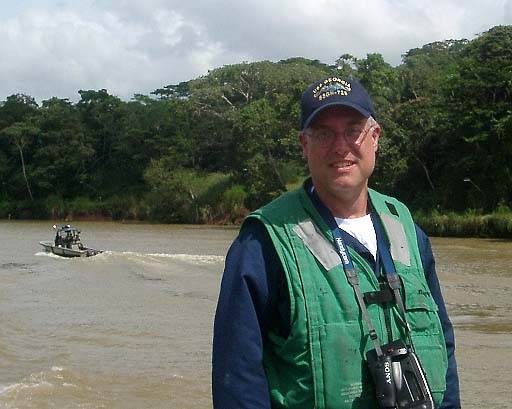
Earthquakes in Japan are common, but this one was bigger that usual. And, sitting in my apartment 12 stories above the ground, scary. Earthquakes are among the strangest experiences you can have.
Details.
じゃあね
Friday, February 4, 2011


Tuesday, February 1, 2011
Japanese Statues and Sculpture - Jizō Bosatsu
Of course this is a topic that would require a book many hundreds of pages long to cover. I can, at least, offer a few pictures.
Some of the pictures that I took on Mt. Takao were of Jizō Bosatsu. From the linked article;

This one is at the bottom of Mt. Takao at the entrance to the Mountain.

This one is at the summit of the Mountain.

A closer view.
Be sure to read the links from the list of the various forms of Jizō. It is very interesting. There is a lot of history here.
Jizō are a great source of comfort for people, especially parents who have lost their children, or had sick children healed.
じゃあね
Some of the pictures that I took on Mt. Takao were of Jizō Bosatsu. From the linked article;
One of the most beloved of all Japanese divinities, Jizō works to ease the suffering and shorten the sentence of those serving time in hell, to deliver the faithful into Amida’s western paradise (where inhabitants are no longer trapped in the six states of desire and karmic rebirth), and to answer the prayers of the living for health, success, children, and all manner of petitions. In modern Japan, Jizō is a savior par excellence, a friend to all, never frightening even to children, and his/her many manifestations -- often cute and cartoon-like in contemporary times -- incorporate Taoist, Buddhist, and Shintō elements.
Jizō is a Bodhisattva (Jp. Bosatsu), one who achieves enlightenment but postpones Buddhahood until all can be saved. Jizō is often translated as Womb of the Earth, for JI 地 means earth, while ZŌ 蔵 means womb. But ZŌ can also be translated with equal correctness as “store house” or “repository of treasure” -- thus Jizō is often translated as Earth Store or Earth Treasury. Jizō embodies supreme spiritual optimism, compassion, and universal salvation, all hallmarks of Mahayana Buddhism.

This one is at the bottom of Mt. Takao at the entrance to the Mountain.

This one is at the summit of the Mountain.

A closer view.
Be sure to read the links from the list of the various forms of Jizō. It is very interesting. There is a lot of history here.
Jizō are a great source of comfort for people, especially parents who have lost their children, or had sick children healed.
じゃあね
Sunday, January 23, 2011
Mt. Takao: Yakuo-in Temple
On Mt. Takao is the Takaosan Yakuoin Temple. Built in 744 by Gyoki Bosatsu under the direction of Emperor Shōmu, it has an amazing history and is the home to thousands of ancient documents.
Emperor Shōmu is also behind the construction of the Nihon-ji Daibutsu. The Temple is dedicated to Yakushi Nyorai, the Medicine Buddha. The Daibutsu (大仏) at the Nihon-ji Temple and Monastery complex on Mt. Nokogiri is a statue of the Medicine Buddha. Note the medicine bowl in his hands.
On our way down from the summit of Mt. Takao we came to our first encounter with the Temple complex.
The Okunoin Fudou-do was originally called the Goma-do and was located near the Main Hall, but was moved to its present location at the upper-rear edge of the Temple property.
During the hiking season there are large crowds visiting the Temple and buying souvenirs (omiyage - お土産 ).
The Temple has an official web site in Japanese and English. Go there are read about the history of the Temple. You can also read about the various festivals held there and the etiquette to be practiced there.
Emperor Shōmu is also behind the construction of the Nihon-ji Daibutsu. The Temple is dedicated to Yakushi Nyorai, the Medicine Buddha. The Daibutsu (大仏) at the Nihon-ji Temple and Monastery complex on Mt. Nokogiri is a statue of the Medicine Buddha. Note the medicine bowl in his hands.
 |
| Detail of the Stone Buddha on Mt. Nokogiri |
 |
| Okunoin Fudou-do Hall |
 |
| The Main Hall |
 |
| The Monastery. Visitors cannot enter this area. |
 |
| The Izuna Gongen-do Hall |
じゃあね
Friday, November 26, 2010
Mt. Takao - 高尾山 Trail 6 and the Summit
Everyone knows about how the Japanese people love viewing the cherry blossoms in the spring. I have written about the Cherry Blossom Festival at the Naval Base in Yokosuka. Although it is only slightly less a party atmosphere, the autumn viewing of the changing color of maple leaves (and autumn colors in general) is also very popular. One of the great places to do this is on the very popular hiking trails of Mt. Takao. My wife and I did this twice this year.
The Mountain is in the far western edge of Tōkyō (東京) in the town of Hachiōji (八王子市). The Keio Line has a station at the entrance to the mountain. So, the Mountain is not difficult to get to. It is a very popular place for Tōkyō-ites to hike. As a result, during the leaf viewing season the Mountain sees a very large number of hikers.
When you arrive at the entrance you may choose a number of trails to use. You can catch the cable car and ride half-way up the Mountain, then catch Trails 1 - 5 to get around. You may also hike Trail 1 up from the bottom. The most difficult trails are Trail 6 and the Inariyama Trail. These are the most difficult but also the most beautiful for hiking. Trail 6 runs along a creek almost all of the way up and is the most beautiful of all. Trail 6 features not only the creek - complete with waterfall, but Shinto and Buddhist (I think) prayer sites.
I have way too many pictures to include in one post, so I will just post a few views of Trail 6 with no comment other than the captions. I will save pictures of Trail 1 and the Yakuo-in Temple and Monastery complex as well as the Inariyama Trail for another post.
That is enough for now. I'll post pictures from Trail 1 and the Inariyama Trail in a later post.
じゃあね
 |
| Mt. Takao Entrance - 高尾山口 (Takaosanguchi) |
When you arrive at the entrance you may choose a number of trails to use. You can catch the cable car and ride half-way up the Mountain, then catch Trails 1 - 5 to get around. You may also hike Trail 1 up from the bottom. The most difficult trails are Trail 6 and the Inariyama Trail. These are the most difficult but also the most beautiful for hiking. Trail 6 runs along a creek almost all of the way up and is the most beautiful of all. Trail 6 features not only the creek - complete with waterfall, but Shinto and Buddhist (I think) prayer sites.
 |
| Site map at Takaosanguchi |
Trail 6
 | ||
| Trail 6 Entrance |
 |
| Waterfall and Shinto Shrine near Trail 6 |
 |
| Trail 6 |
 |
| A view through the trees on Trail 6 |
The Summit
 |
| At the Visitor's Center at the Summit |
 |
| Mt. Fuji seen from Mt. Takao. Shingen came from over there. |
 |
| A stroll around the summit. |
 |
| Tōkyō seen from the summit |
That is enough for now. I'll post pictures from Trail 1 and the Inariyama Trail in a later post.
じゃあね
Wednesday, October 6, 2010
Beer in Japan - Part 1
I am going to be optimistic here and assume that there will be many more beer posts. Beer is a hobby of mine. Not only do I enjoy drinking good beer, I brew my own. I am very critical, and enjoy sharing excellent beer with my friends. Some of my brothers and sisters in the Orthodox Church of America (Holy Trinity in Tacoma, Washington) may remember an amber ale that I brewed for a sausage barbecue held by a church group there some time ago.
The beer situation in Japan is not nearly as good as it is here in the U.S., but progress is being made. And you can, of course, get anything in the world in Tokyo or Yokohama.
During my next maintenance project in Japan my boss (several steps above me) and I will be visiting places that serve great beer. If time permits, we will attempt to visit the occasional brewery and maybe a whiskey distillery or two. This boss of mine is an expert in Belgian style ales, a style which I like very much.
We have already started. On March 16th, 2010 we visited Patrasche in Kawasaki City.

The place is beautiful. Upon entry we found the magnificent bar.

Although the staff had no one who spoke English, it was not a problem. In Japan restaurant menus have pictures (even the nice restaurants) and beer is a universal language. Petrasche is serious about beer, as you can see by the lamps on the wall.

The beer list was very long, taking several pages of an extensive menu.

They even have my favorite beer in the world, an excellent Flemish Red Ale.
All in all it was a great visit.

じゃあね
Saturday, September 18, 2010
Sea of Japan - Part 3
During the underway we got to see an UNREP (Underway Replenishment).

We took on food, aviation fuel, and other stuff.

Some goods were brought over by helicopter.
Finally, we had to COD off of the Ship immediately or we would be too far away from Okinawa and would have to stay onboard until Singapore. So, off we went after have a nice reception group meeting with the Commanding Officer to include ice water and pastries. That ice water was nice!

So, we caught the next COD flight and off we went.

Arriving at Kadena Air Force Base on Okinawa.
I did not get too many photographs on Okinawa. We were there for 3 - 4 days, but stayed mostly on base for various reasons that I will not get into here. Still, here are the Shiisa.

Shiisa are normally presented in pairs. The one on the left has a closed mouth to keep the good spirits in.

The one on the right has an open mouth to chase away the evil spirits. This is the guardian.
These Shiisa are on guard at the main gate into Kadena AFB.
じゃあね
Wednesday, September 8, 2010
Sea of Japan - Part 2
I had too many photographs for a single post, so here are some more. These are more about the ship than the aircraft. It is hard to choose which photos to include, I have many that are of interest but I just cannot post them all.
Anyway, my accommodations were good. I was assigned to a two-man stateroom. Ahhhh, the privileges of a little seniority.

My bunk was the one on the top.
Cool things on the Ship include the enormous anchor, which we cannot see because of its location, and the anchor windlass that raises and lowers the anchor. Also cool is the enormous chain

...and the chain covers, decorated with the American and Japanese flags.

We took our meals in Wardroom 3

...with the officers. The junior enlisted mess decks are not quite so nice, although we ate exactly the same food.

While we were in the Republic of Korea (South Korea) we had many visitors from Busan. These included military and political VIPs (including extremely senior people) as well as local citizens. Everyone seemed to have a good time and enjoyed their visits. Hundreds of smiling faces were everywhere.
During the port call the hangar deck was decorated with the 13 starred flag.

It normally looks more like this...

As I have mentioned elsewhere, we were there during the military exercises that took place in the Sea of Japan (that irritated Kim Jong Il so much).
In this picture, the ship in front (to my left) is of the ROK Navy and the one behind (to my right) is of the U.S. Navy.

That's all for now. I will do one more Sea of Japan post to include some pictures in Okinawa.
じゃあね
Anyway, my accommodations were good. I was assigned to a two-man stateroom. Ahhhh, the privileges of a little seniority.

My bunk was the one on the top.
Cool things on the Ship include the enormous anchor, which we cannot see because of its location, and the anchor windlass that raises and lowers the anchor. Also cool is the enormous chain

...and the chain covers, decorated with the American and Japanese flags.
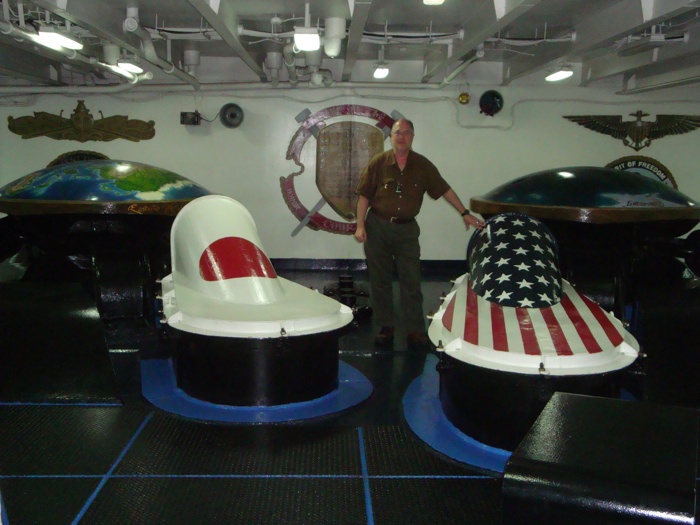
We took our meals in Wardroom 3

...with the officers. The junior enlisted mess decks are not quite so nice, although we ate exactly the same food.

While we were in the Republic of Korea (South Korea) we had many visitors from Busan. These included military and political VIPs (including extremely senior people) as well as local citizens. Everyone seemed to have a good time and enjoyed their visits. Hundreds of smiling faces were everywhere.
During the port call the hangar deck was decorated with the 13 starred flag.

It normally looks more like this...

As I have mentioned elsewhere, we were there during the military exercises that took place in the Sea of Japan (that irritated Kim Jong Il so much).
In this picture, the ship in front (to my left) is of the ROK Navy and the one behind (to my right) is of the U.S. Navy.

That's all for now. I will do one more Sea of Japan post to include some pictures in Okinawa.
じゃあね
Subscribe to:
Posts (Atom)